Guam drives on the right, so if you are used to driving in the U.S., Korea or Taiwan, the basics will feel familiar. Still, a few local rules catch visitors off guard: a 45 mph limit that applies island-wide, school buses that stop traffic in both directions, a yellow center lane, and a strict phone law that covers you even at a red light.
Rather than listing rules one by one, this page walks you through the order in which you will actually meet them, from picking up your car to what to do if an accident happens.
Before you start: three quick checks
- Do you have your original driver’s license?A valid license from another U.S. state or territory lets you drive in Guam for up to 90 days after arrival. Licenses issued by Japan, Korea, Taiwan and certain other countries are valid for 30 days.
- Is your navigation already set?In Guam you may not hold or operate your phone while driving, and that includes waiting at a red light. Enter your destination while you are still in the parking lot. Calls are allowed only hands-free (for example via Bluetooth), with an earpiece in one ear at most.
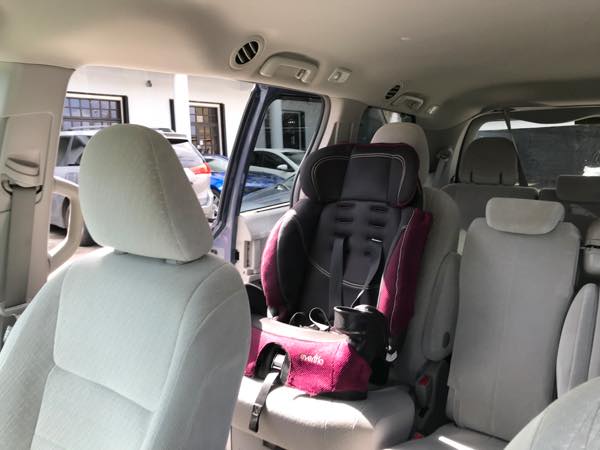
- Is everyone buckled up?Rear-seat passengers must wear seat belts too. Children under 4 need a child safety seat, and children aged 4 to 11 who are shorter than 4 ft 9 in (about 145 cm) need a booster seat or other suitable seat. Please request child seats when you book.
Scene 1: Pulling out of the parking lot
Parking lots at hotels and shopping centers open straight onto busy roads. Before pulling out, check both directions, then merge into the lane on the right side of the road.
If you are turning left out of a driveway, cross the near lanes completely and enter the far side of the road. Take your time during the first few minutes; staying in the correct lane matters more than keeping up with traffic.
Scene 2: Your first intersection
Stopped at a red light
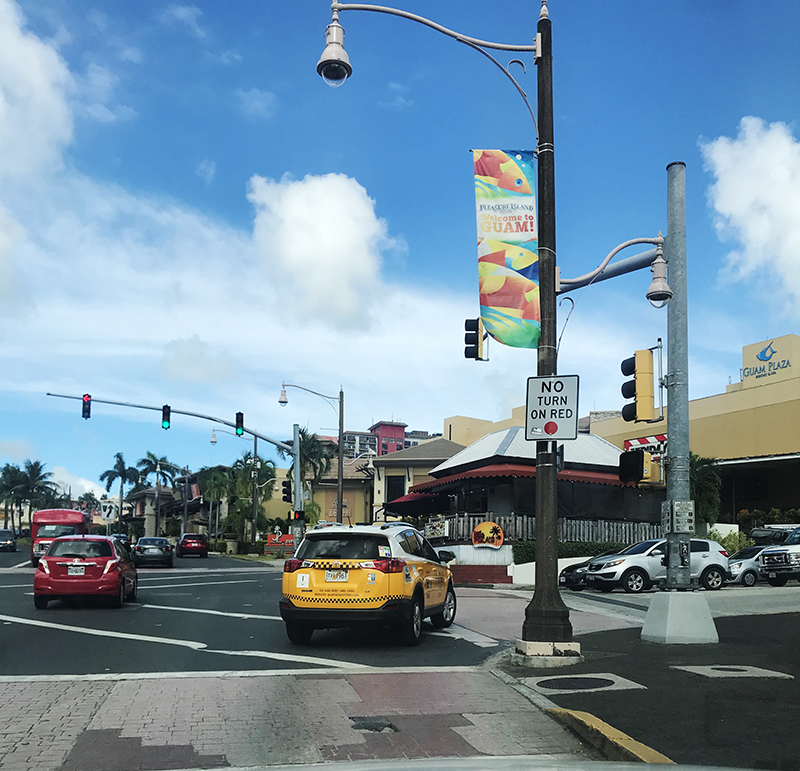
At many intersections in Guam you may turn right on red. Follow these steps:
- Stop before the stop line until your wheels are completely still
- Check the crosswalk on your right for pedestrians
- Wait for a gap in traffic coming from your left
- If it is safe, turn tightly along the right edge of the road
Where a “NO TURN ON RED” sign is posted, wait for the green light. Turning right on red is permitted, not required, so it is perfectly fine to wait for green until you feel comfortable.
Intersections without signals or signs
When two vehicles enter an intersection at about the same time, the driver on the left yields to the driver on the right. At a STOP sign, always come to a full stop, even if no other car is in sight.
Scene 3: On the main roads
45 mph is the ceiling everywhere
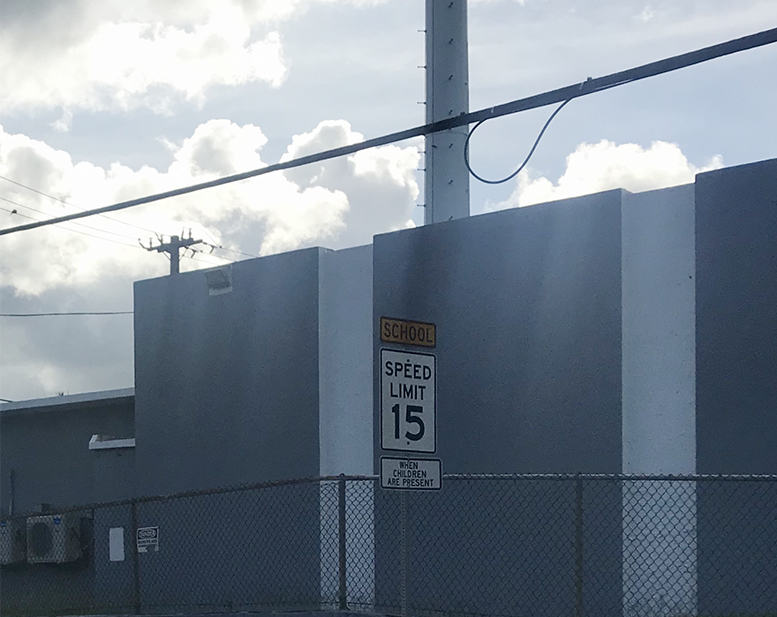
Guam law makes any speed over 45 mph unlawful anywhere on the island. Where a lower limit is posted, follow the sign; many roads are posted at 35 mph, and some school zones are posted at 15 mph when children are present. Slow down further in rain or heavy traffic.
Use the yellow center lane only right before a left turn
Many main roads have a center lane bordered by yellow lines. Pull into it just before you turn left into a shop or side street, and wait there for a gap in oncoming traffic. Do not drive along it or use it to pass other cars. If you need to make a U-turn, do not swing around from the center lane; go on to a place where signs allow it, or to the next intersection.
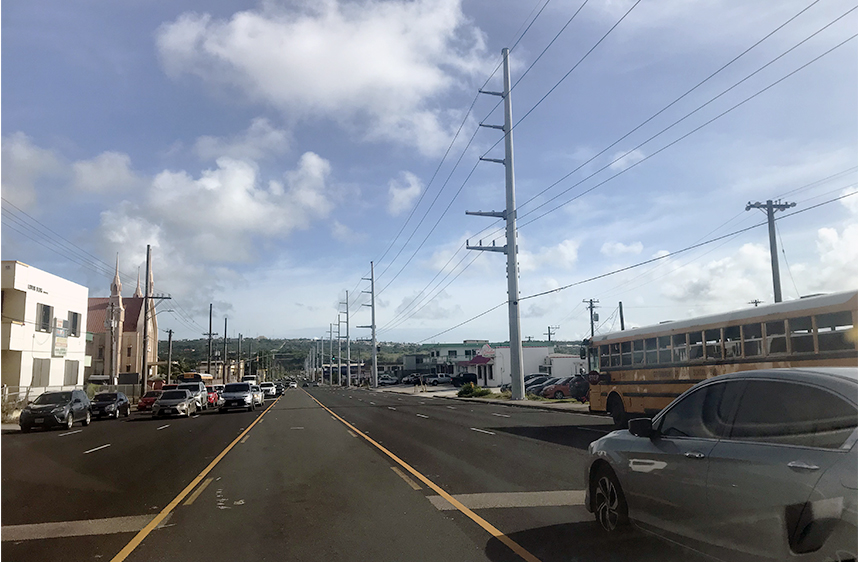
When a school bus stops, both directions stop
If a school bus stops to let children on or off and shows its red lights or STOP sign, traffic behind the bus and traffic coming the other way must both stop. Stay stopped until the children have left the road and the bus moves off.
For regular buses, slow to 10 mph or less when passing a bus that is picking up or dropping off passengers on the roadway.
When a sudden downpour hits
Heavy rain can arrive quickly even on a sunny day. The road is especially slick in the first minutes of rain, so turn on your headlights, reduce speed and leave more room to the car ahead. Do not drive into roads where water has pooled deeply.
Scene 4: Parking at your destination
In parking lots, keep your car inside the white lines. When parking on the street, face the direction of traffic and pull up along the right-hand curb.
Do not park in places like these:
- Inside an intersection, on a crosswalk, or close to either
- Near a fire hydrant or in front of a fire station entrance
- Anywhere that blocks a driveway or parking lot entrance
- Accessible parking spaces and the striped area next to them
- Areas marked “NO PARKING” or “TOW AWAY ZONE”
When you leave the car, take bags and shopping with you or move them into the trunk rather than leaving them on the seats.
Scene 5: Days when you plan to drink
Besides drunk driving by the driver, it is illegal in Guam for passengers to drink inside a moving vehicle, and for an opened container of alcohol to be kept within reach while the car is on a public road. Put any leftover drinks in the trunk. On days you plan to drink, choose a driver who will not drink, or take a taxi.
Scene 6: If you have an accident
No matter how carefully you drive, accidents can happen. This is the part of the page we most want every renter to read.
At the scene
- Stop in a safe place and turn on your hazard lights
- Help anyone who is injured; call 911 if there are injuries, fire or other danger
- Exchange names, contact details, driver’s license and license plate information with the other party
- Once stopped, photograph the vehicles’ positions, the damage and the surroundings
- Call JAPAN Rent-A-Car
Do not agree on who is at fault at the scene or settle privately in cash.
Report to the police within 24 hours
Under Guam law, any accident causing injury or apparent damage of $50 or more must be reported in writing to the police within 24 hours. Repairing even a small scrape on a rental car almost always costs more than $50.
At JAPAN Rent-A-Car, accidents or damage that were not reported to the police within 24 hours (with no accident number) are not covered by insurance or protection plans. If a police accident report cannot be obtained, the customer is responsible for all resulting costs. Please do not skip the report because the other driver says it is fine or the damage looks minor.
The following charges also apply in the event of an accident:
- Accident processing legal fee: $150 (charged whether or not you were at fault)
- Non-operation charge (NOC): $250 if the car can still be driven and rented, $400 if it cannot (waived if you purchased NOC coverage)
Pre-drive checklist
- I have my original driver’s license
- My destination is entered in the navigation
- Everyone is wearing a seat belt
- Right on red only after a full stop
- Never above 45 mph, and lower when signs say so
- Stop for a stopped school bus, even from the opposite direction
- After any accident, call the police and JAPAN Rent-A-Car (within 24 hours)
This page reflects Guam law and JAPAN Rent-A-Car’s coverage terms as of September 2026. On the road, always follow police officers’ directions, traffic signals, signs and road markings.