(This is an older post. The information reflects conditions at the time it was originally published — stores, prices and promotions may have changed since then. Please check our official website or on-site signage for current details.)
Taotaomona
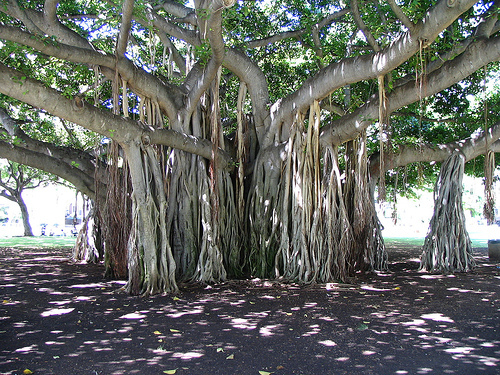
Taotaomo’na, literally the people of before,
refers to ancestral spirits that inhabited the earth along with the living.
Ancient Chamorros believed the world around them was full of spirits who
provided both daily protection and assistance in their tasks, but also created
dangers and problems.
The connection between Chamorros and these
spirits has changed over time, primarily due to cultural changes that came
about from Spanish colonization and Christianization. Slowly over time, these
spirits have changed from the ante of ancestors to the wily ghosts, devils and
demons that play tricks or cause harm today. Taotaomo’na can be defined in
different ways, depending on their relationships with the living.
Taotaomo’na is therefore a term which could
refer in general to all the spirits of Chamorro ancestors, to all of those who
have come before.
These spirits played a huge role in the daily
life of Chamorros offering assistance and protection with all sorts of daily
tasks. These spirits were treated as members of the family and were referred to
be name or through terms of endearment.
Santa Marian Kamalen
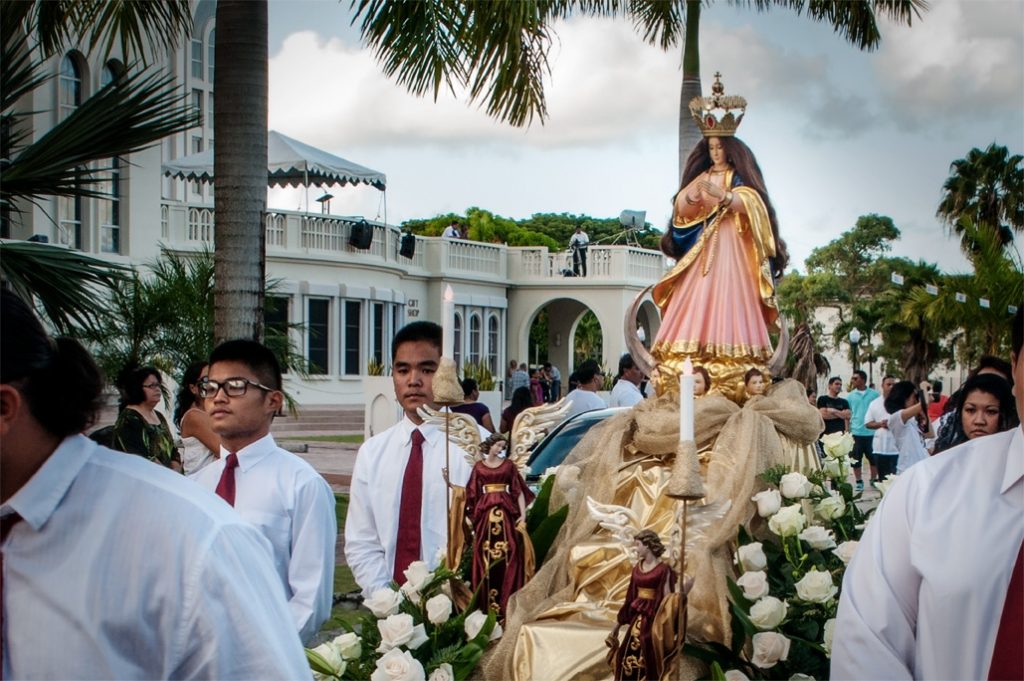
Santa Marian Kamalen, also known as Our Lady
of Camarin, is the patron saint of Guam. The 300-year-old Santa Marian Kamalen
statue is a revered icon, and its unknown origins are explained through legend.
The actual statue of Santa Marian Kamalen is
28 3/4 inches tall and weighs 48 1/2 pounds. It is made of wood, except for the
ivory face and folded hands. She is painted with a pink and blue gown and sits
high at the Dulce Nombre de Maria Cathedral-Basilica in Hagåtña in a niche
behind the altar.
Guamanians celebrate Feast of the Immaculate
Conception each Dec. 8, Catholics turn out by the thousands in Hagåtna to honor
her in a procession around the island’s capital.
She is one of the most important icons in
Guam’s history, religious or otherwise.
There are multiple versions of the legends
that explain her origin:
According to one version of the legend, a
fisherman from Merizo went fishing, and spotted a statue of the Virgin Mary on
the ocean floor. He swam underwater to try to approach the statue, but to his
surprise it moved away. No matter what he did, he could not close the distance
between the statue and himself.
He returned to shore and sought advice from
the village priest. The priest told the fisherman to dress in his Sunday
clothes and try again. He did so, and this time had no trouble in getting the
statue.
Another version of the legend has it that the
fisherman saw the statue floating in the water, escorted by two gold-spotted
crabs, each bearing a lighted candle between its claws. She thus also became
known as the Lady of the Crabs.
When the fisherman returned, he took the
statue to the Presidio, or main barracks which was still under construction.
There the statue was relegated to a tool shed, in Spanish camarin and in
Chamorro kamalen. Thus, she became known as Santa Maria del Camarin in Spanish,
or Santa Marian Kamalen in Chamorro. She was also known as the Lady of the
Barracks.
Puntan Dos Amantes
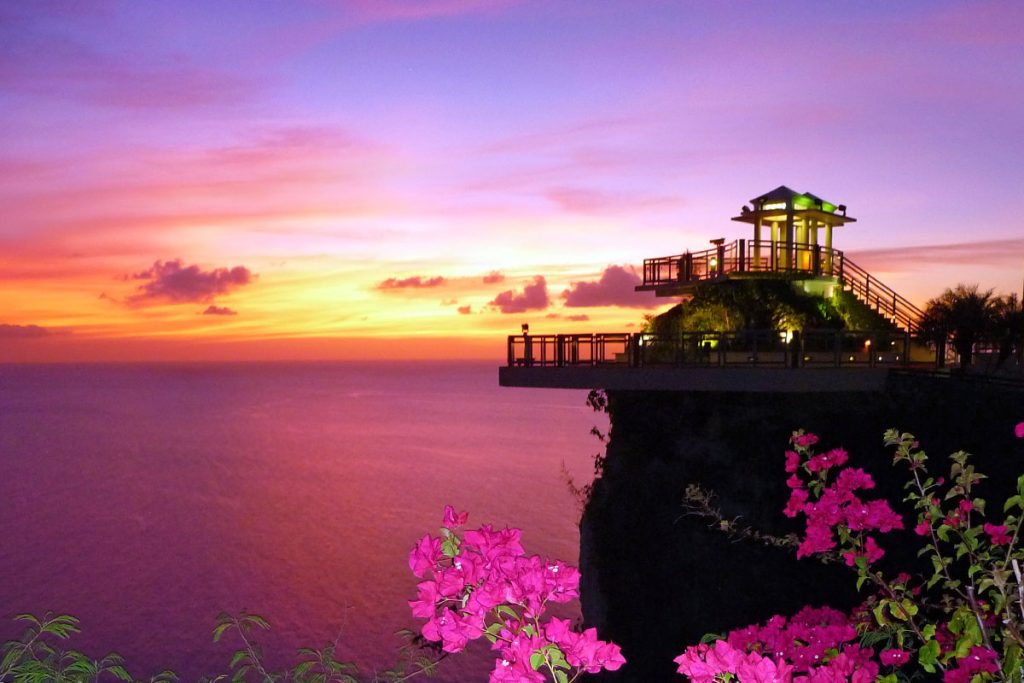
The story tells of two Chamorros who loved
each other but their love was unacceptable because he was a high caste man
(matao) and she a lower caste woman (manachang). Mataos were strictly forbidden
from allying themselves with those from the lower caste.
A certain matao of the village of Gnaton fell
in love with a young and pretty manachang girl and fled with her. He found no
asylum among another native group, however, as he refused to part with her.
Pursued by his relatives, the young lovers
wandered for some time in the most inaccessible wood and rocky areas; but so
precarious and wretched an existence reduced them to despair. Determined to put
an end to it, they built a tomb of stones and place in it the infant that was
the sad fruit of their love.
Then, lost and distracted, they climbed to the
very summit of a high, steep-sided peak beside the sea. Binding themselves
together by the hair, and clasping one another, they cast themselves from that
peak into the waves below.
The cape was named by the Spanish, Cabo de los
Amantes (Lovers’ Cape), now known as Puntan Dos
Amantes (Two Lover’s Point).
But since the story changed to include a Spanish figure. It
goes as follows:
Once, long ago, during a time when Spain claimed the Mariana
Islands, there was a family who lived in Hagåtña,
the capital city of Guahan. The father was a wealthy Spanish businessman and the mother, a daughter of a great maga’lÃ¥hi or Chamorro
chief.
Their oldest daughter was a beautiful young
woman, admired by all for her honesty, modesty, and natural charm. One day,
against her will, the girl’s father arranged for her to take a powerful Spanish
captain as her husband.
But the girl met and fell in love with a
common Chamorro man, and they promised each other their love.
When the girl’s father learned of the couple,
he grew angry and demanded that she marry the Spanish captain at once – but she
found her lover and escaped.
Her father, the captain and all the Spanish
soldiers pursued the lovers up to the high cliff above Tumon Bay. The lovers found themselves trapped
between the edge of the cliff and the approaching soldiers.
The lovers tied their long black hair together
and kissed for the last time before leaping to their deaths. They were never
seen again.
Today the place where they jumped is known as
Puntan dos AmÃ¥ntes or Two Lover’s Point. The site has been restored and
modernized, and visitors still visit there to learn about the two lovers, and
enjoy one of the most breathtaking aerial sites of Guam’s coastline.