(This is an older post. The information reflects conditions at the time it was originally published — stores, prices and promotions may have changed since then. Please check our official website or on-site signage for current details.)
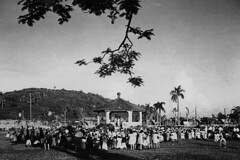
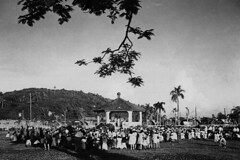
“First Liberation Mass”
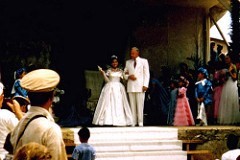
Guam’s biggest celebration
After World War II was over community leader Agueda Iglesias Johnston convinced US military leaders on
Guam to support a celebration to commemorate the Liberation of the island from
the Japanese. This celebration continues to this day as one of Guam’s holidays
– Liberation Day, which is celebrated on July 21st.
While there were Liberation Day
commemorations in the late 1940s and then Liberation Day celebrations in the
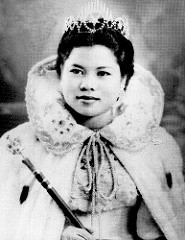
early 1950s, the first Liberation Day queen contest wasn’t held until 1948. Beatrice Blas Calvo Perez was the
first Liberation Day Queen of Guam. The winner was declared based on ticket
sales, just as it is today.
Follows
the pre-war tradition of annual fairs
Before the outbreak of World War II
on Guam, some of the most anticipated events were the annual fairs held at the
historic Plaza de España in Hagåtña and later at the Bradley Park in Anigua.
The Guam Island Fair was an opportunity to show off an array of talent,
competition, display prized products and socialize. There were always queens
that graced the fair grounds with all their beauty, pride and splendor.
Today, the committee that plans
Liberation Day is still called the Guam Island Fair committee.
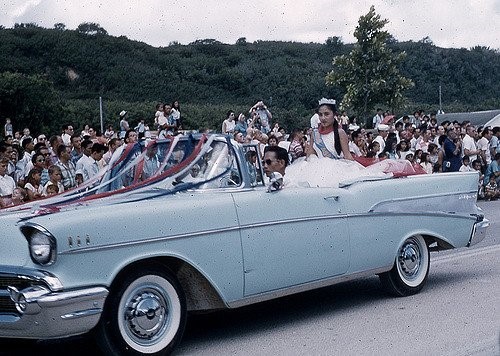
Liberation Day festivities include a
queen contest, a summer carnival and a mile long parade on Marine Corps Drive
in Hagåtña. Thousands participate by making floats or marching in the
parade along with the US military. More recently various ethnic groups,
including the Japanese, take part in the parade as well, showing their love for
Guam.
Solemn commemorations at massacre
sites in Merizo, Agat, Yona and Yigo as well as the Asan Overlook and other
World War II memorials are also held at this time.
Multi-day
extravaganza
Guam’s celebration of Liberation is
not confined to one just day. Since its beginning, the events have always been
a multi-day extravaganza. In past Liberation celebrations, activities have
included sports events (including boxing and wrestling), agricultural fairs,
bicycle races, greased pig catching competitions, a battle of the bands in
1971, and even a circus.
Traditionally though, the events
include religious and memorial services, the Liberation queen contest, a
carnival, and of course, the parade. The parade route is from Adelup to the
Paseo de Susana.
The route has been changed in the
past, however. In 1976 it started at Adelup and ended at Camp Asan. In 1983 it
started at Adelup and ended at the Hagåtña pool, rather than Paseo.
The carnival’s location has changed
over the years as well. While it is usually at Paseo it has been held at the
former Yigo Amusement Park, the Harmon Cliff line, and Tiyan.
Village
floats are best loved in the parade
The parade floats are both
commercial and civic. The village floats are the best loved, as volunteers from
many of the villages get together to create floats using natural materials to
represent the theme for the year. Oftentimes the floats include hanging fresh
fruits and betelnut that is thrown to the parade watchers, or live performances
that go on for the whole parade.
Some dedicated parade watchers line
up hours before the sign-up sheet for parade spots becomes available. Parade
spots are given on a first-come, first-served basis. Families and businesses
usually set up their tents the night before and camp out before the parade
happens on Liberation Day, usually starting at 10 am.
During the parade, the parade route
is shut down, the grand marshal leads the bands, marching units, and floats.
Government officials make speeches, there are musical performances, and spectators
watch, barbecue, and celebrate.